
You Can’t Fix Dead
Self-help can change your behavior, but only Jesus can raise the dead.

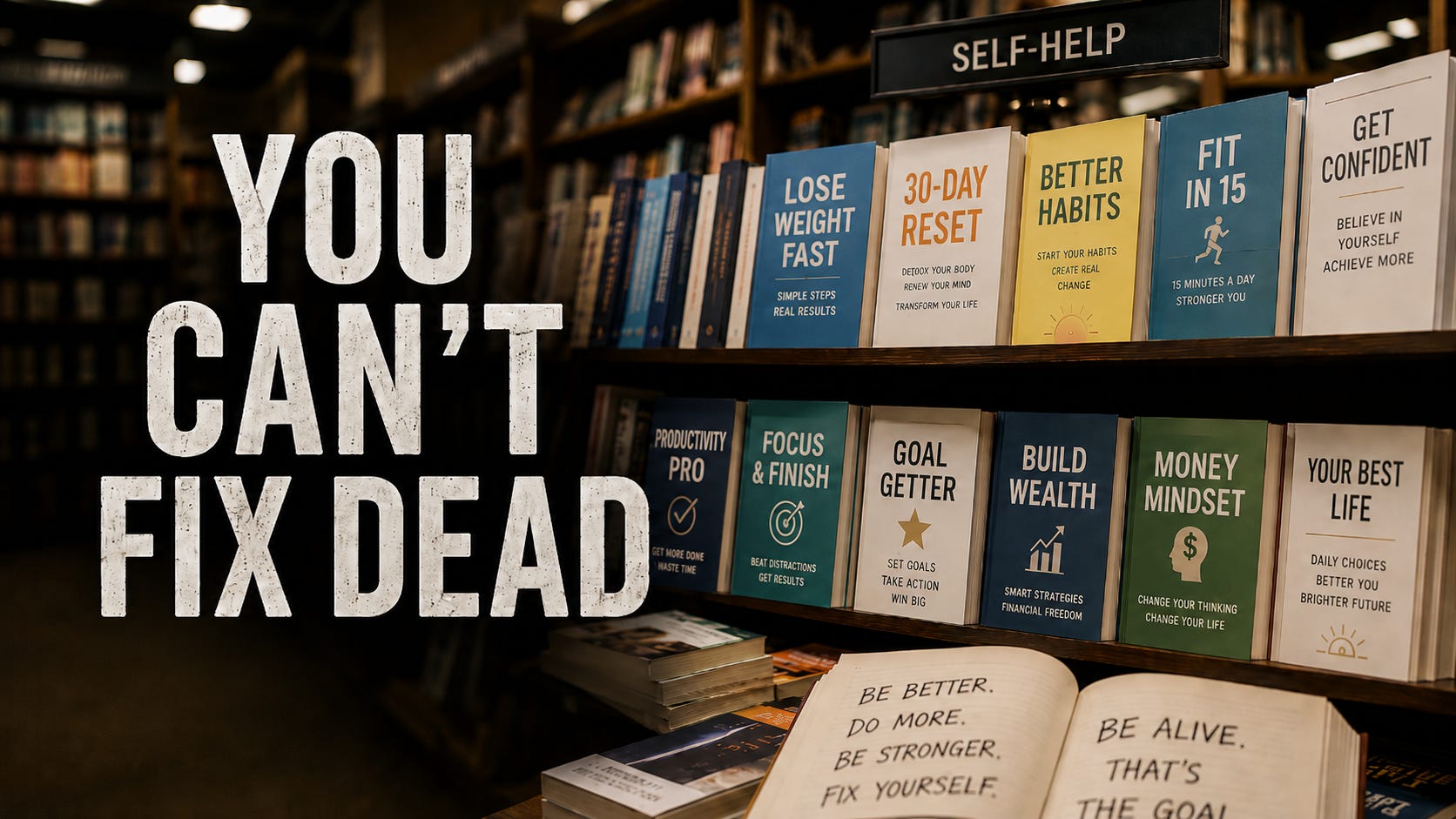
Ever been to a bookstore?
No? Well, maybe you should check one o
ut sometime. And when you get around to it, look for the “Self-Help” section. It won’t be hard to find. There are books on how to get in shape, make more money, become more confident, parent better, beat destructive habits, overcome insecurity, and probably how to stop buying so many self-help books.
And they’re not all bad. Discipline matters. Habits matter. Wisdom matters. Sleep, exercise, therapy, budgeting, accountability, and friendship all matter. But underneath a lot of self-help is one foundational assumption: You can fix yourself. Because if you can’t help yourself… why read a self-help book?
You’ll find the problem with that premise in a different book within a different section of that bookstore you’re going to visit. It’ll be in the “Religious Books” section.
The Bible isn’t against effort, discipline, wisdom, or growth. In fact, Scripture calls us to obedience, repentance, self-control, endurance, and action. Biblical Christianity is not sitting on your couch waiting for a craving for holiness to come over you like a craving for tacos. On a Tuesday.
But the Bible is absolutely opposed to the idea that what’s broken in you can be repaired by you.
Maybe you’re thinking, Wait a second. I can work hard and fix my behavior. I can improve my attitude. So…can’t I make myself better?
Sure.
Well, kind of.
There is a level of change a person can accomplish through discipline, effort, pressure, willpower, and good systems. Some people can build a pretty impressive version of themselves that way.
The problem is that none of it reaches deep enough. The Bible’s diagnosis is not that we are merely underdeveloped, poorly coached, or lacking the right morning routine. The Bible’s diagnosis is that we are sinners. Sin is not just something we do. It’s something that has infected what we are.
If the problem were only behavior, then with enough time, effort, discipline, pressure (and maybe a very aggressive spreadsheet), we could eventually clean ourselves up. But if the problem goes deeper than behavior, then self-help eventually hits a wall.
It can manage symptoms, improve appearances, and make you more functional. And again, that’s not nothing. I am very much in favor of people becoming more functional. (So is everyone who has ever had to sit through a meeting that should have been an email.)
But functional is not the same as free. Improved is not the same as redeemed. Behavior modification is not resurrection. Why? Because most self-help assumes your deepest problem is weakness. You need more discipline, better habits, clearer goals, stronger boundaries, a better morning routine. Some of that may help. But the Bible presses deeper. It says your deepest problem is not weakness. It’s death.
You can improve weakness. You can coach weakness. You can manage weakness. But you cannot self-help your way out of a grave.
Isaiah 64 says, “all our righteous acts are like filthy rags.”
Think about that a second. The scary part of the Bible is not only that God sees our wickedness. It’s that compared to the holiness of God, even our goodness falls short—our best efforts, our cleaned-up life, our “I’m not as bad as most people” speech we keep ready in our back pocket.
The standard isn’t “better than you used to be.” The standard is God. And once God is the standard, self-help can’t save you. It can’t even get close.
That’s why the gospel is not advice. It’s not God saying, “Here are five tips to become a better you.” It’s not a spiritualized self-improvement plan with a worship playlist going in the background.
The gospel is an announcement: Jesus lived the righteous life you could not live, died the death you deserved to die, and rose again so dead sinners could be made alive in Him.
That’s resurrection, not self-improvement, because how can something broken at its core fix itself? How can something dead raise itself? How can sinners make themselves righteous before a holy God? They can’t. You need Someone outside of you. Someone whole. Someone holy.
You need Jesus.
But here’s where this gets sneaky: the self-help instinct doesn’t disappear once we become Christians. We may stop thinking we can save ourselves, but we still assume we should be able to sanctify ourselves. We think, Okay, Jesus saved me. Now I need to clean myself up so I can be worthy of Him.
Which sounds humble, but it’s really just self-reliance wearing church clothes.
We talk a lot about depending on God, but I think our understanding of dependence is often skewed. A lot of us think the Christian life is supposed to work like this: I have a problem with pride, so I pray about it, work on it, eventually master it, and then I’m good to go in that area. Then lust. Then gossip. Then insecurity. Then anger.
Down the list we go, thinking one day we’ll become a super-Christian with no problems and fewer reasons to go back to Jesus.
But that’s not the biblical picture at all. The goal of the Christian life is not independence. God is not in heaven saying, “Come on, Mills. I distinctly remember you bringing Me this same issue in April of 2011. And now you’re bringing it again? Seriously? I thought we handled this.”
That’s not how sanctification works. Sanctification doesn’t produce independence from God. It produces deeper dependence on God. As you grow in Christ, you don’t discover fewer reasons to need Him. You discover more.
As the Spirit works in you, He reveals deeper pride, deeper fear, deeper selfishness, deeper wounds, deeper idols. So you go back to Him again. Not because you’re failing at Christianity. But because that is Christianity.
You take your pride to God, and He helps you. Then later, He reveals pride under the pride. You take that too. You take your anxiety to God, and He gives peace. Then later, He reveals the control beneath the anxiety. Then the fear beneath the control. Then the unbelief beneath the fear.
And the whole process doesn’t make you say, “Wow, I’m getting so strong I barely need God anymore.” It makes you say, “Apart from Him, I can do nothing.” Which, conveniently, is exactly what Jesus said:
“I am the vine; you are the branches...for apart from me you can do nothing.”
(John 15:5)
That’s not an insult. It’s an invitation. Jesus isn’t trying to humiliate you with your weakness. He’s trying to free you from the illusion of your strength.
Paul says, “walk by the Spirit, and you will not gratify the desires of the flesh.” Then a few verses later: “If we live by the Spirit, let us also keep in step with the Spirit.”
(Galatians 5:16, 25)
Notice the language. Walk by the Spirit. Keep in step with the Spirit. That’s daily. Ongoing. Moment-by-moment. You don’t overcome sin just by trying harder not to sin. You overcome sin by walking with the Spirit.
You fight, but you fight to depend. You work, but you work from grace. You obey, but you obey by the power of the Spirit, not the fantasy that you can fix yourself if you just get serious enough this time.
So yes, work hard. Build better habits. Get counseling if you need it. Go to the gym. Make the budget. Delete the app. Confess the sin. Do the next right thing. But don’t confuse tools with resurrection. And don’t confuse effort with self-salvation. The tools may help you walk differently. They cannot make you alive. Only Jesus does that.
Maybe the question is not, “How do I finally fix myself?” Maybe the better question is, “Where am I still trying to become strong enough that I don’t have to depend on Jesus?” Because that’s not maturity. That’s just pride with a quiet time.
So how do you fix yourself? You don’t. You come to Jesus. And then tomorrow, you come to Jesus again. And then the next day, you keep in step with the Spirit.
My prayer for you today is that you stop trying to self-help your way out of the grave—and find the help you desperately need, not in yourself, but in Christ.

PS — If this served you, consider becoming a paid subscriber to fund the book I’m working on and get extras (printables, verse cards, discussion guides, subscriber-only articles, and more). Thank you for fueling this work.

But functional is not the same as free. Improved is not the same as redeemed. Behavior modification is not resurrection. 🙏🏻🙌🏻
Great read for me today; thanks. WAY too much "LIFE" going on my my life right now.