
Promise Without Presence
Why getting what you want can still leave you empty

What would you choose?
If God showed up in your bedroom tonight and offered you what you’ve been asking for—the door opens, the situation resolves, the future finally feels secure, it’s everything you’ve always wanted… You get the healthy kids, the restored marriage, the dream job, the mountains of cash, the healing.
But the offer came with a condition: you don’t get Him (His presence)…
Would you still take it?
Moses stood in that exact moment in Exodus 33.
He didn’t get there through a quiet devotional mood though. He got there the hard way—through waiting, pressure, disappointment, and a mess that erupted while he was trying to be with God.
By the time we make it to chapter 33, Moses has gone through a lot. His story is basically survival, calling, and nonstop chaos. It’s all about one thing: getting to the Promised Land.
He finds himself leading about a million complaining, very ungrateful people through the wilderness. God parts the Red Sea for them, destroys the Egyptian army for them, and drops manna from heaven—literal miracle food—for them, and yet they keep whining.
Finally though, they make it to Mount Sinai. God tells Moses that He’s going to make the whole nation a nation of priests—a nation that would lead other nations into God’s presence. He invites Moses up on the mountain to talk with Him. The people wait at the foot of the mountain as God gives Moses the Law on tablets of stone.
And in Exodus 32, the people just lose it. They do what people do when heaven feels slow. They panic, demand something immediate, gather their gold, and make a god they could manage. A golden calf.
Quick side note (because it’s not just a them problem): people do weird things in the delay. We don’t usually craft calves out of jewelry. We craft them out of distraction, control, comfort, outrage, consumption, and addiction. Same move, different materials.
Exodus 32 is a wild scene. Meanwhile, God is talking to Moses and basically says, “You better go back down. The people have made a god from gold and are worshipping it. And if you don’t go down and stop them, I’m going to destroy them all.” So Moses goes down. And there’s judgment at the end of chapter 32. People die.
And then, in Exodus 33, God does something that should sober us: He makes an offer.
I will send an angel before you, and I will drive out the Canaanites, the Amorites, the Hittites, the Perizzites, the Hivites, and the Jebusites. Go up to a land flowing with milk and honey; but I will not go up among you, lest I consume you on the way, for you are a stiff-necked people. (Exodus 33:2-3 ESV)
God tells Moses: you can still have the land. You can still move forward. I’ll even send an angel ahead of you to protect you and drive out your enemies. But I will not go with you.
That’s the offer. The promise… without the Presence. Everything they wanted—minus the only thing that mattered.
And it exposes the difference between wanting God’s hand and wanting God’s face. Because “presence” in this passage isn’t “good vibes.” It isn’t a mystical fog machine. It’s personal—God’s “face,” His nearness, His favor, God Himself.
So what does Moses do after God says that? He goes to the place where he’s always met with God. He had set up a tent outside the camp—a “tent of meeting.” Not in the middle of the noise. Not squeezed between everyone’s opinions. Set apart. Deliberate. Intentional.
And when Moses would walk toward that tent, the people would watch. Every time he entered, God’s presence would fall on the tent in a tangible way: a pillar of cloud would descend at the entrance of the tent while Moses talked to God. And the people would see it and worship God.
Let that land: for them, God’s presence wasn’t theoretical. It wasn’t “I feel spiritual today.” It wasn’t a podcast on in the background. It was obvious.
And it’s in that moment—with the cloud and the tent and the weight of what God just offered—that Moses prays one of the most clarifying prayers in the Bible:
“If your presence will not go with me, do not bring us up from here.” (Exodus 33:15)
In other words: “God, I don’t want a future where You’re optional. I don’t want the land if it costs us You. I don’t want progress without Presence.”
Moses knew something most people don’t. Better the wilderness with God than the promised land without Him. Because here’s the truth you don’t learn until you’ve tried the other way:
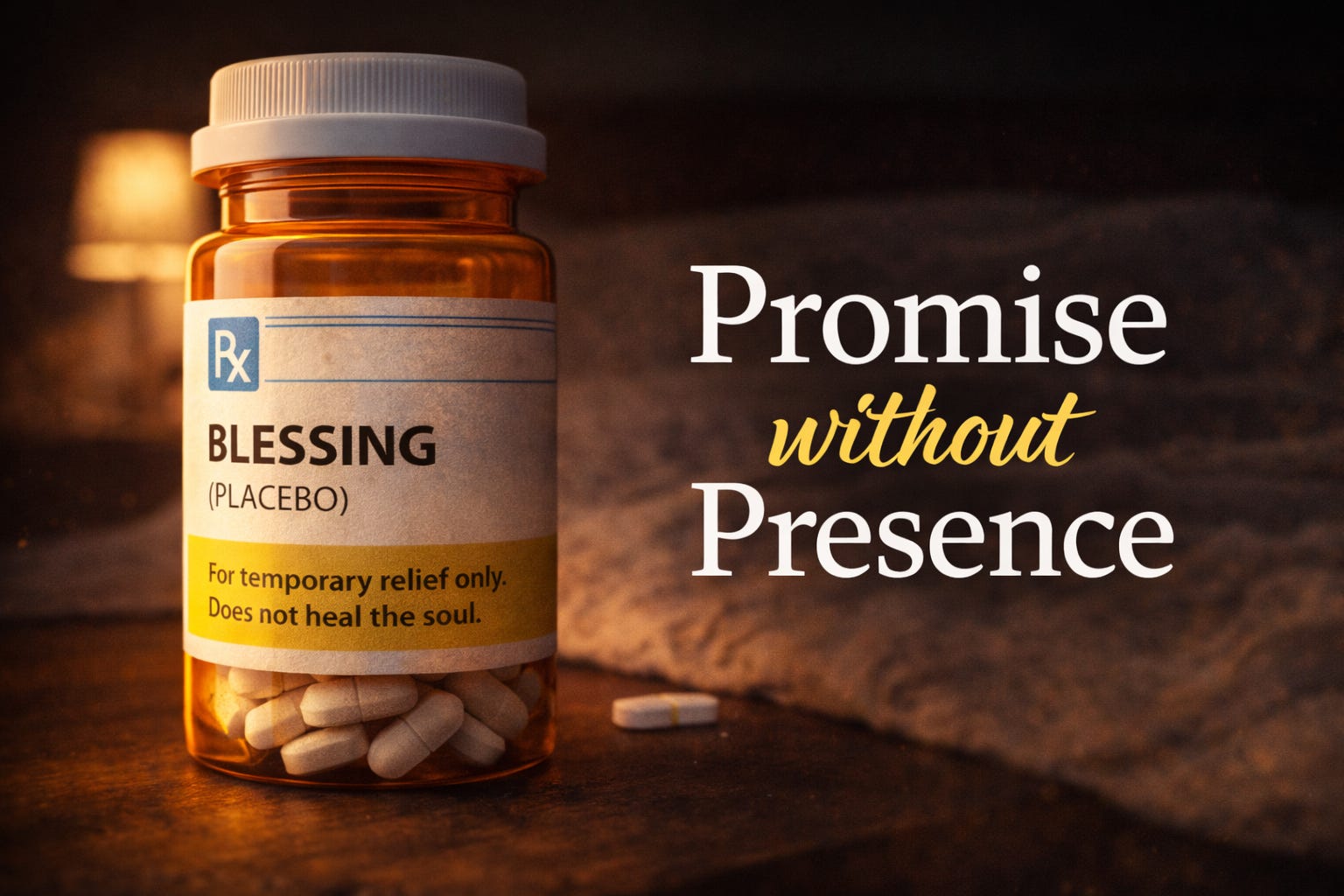
Promise without Presence is just a placebo.
A placebo can feel like medicine. It can produce a temporary lift. It can make you think you’re getting better. But it doesn’t heal the disease. It mimics the effect without delivering the substance. That’s what “blessing” without God does.
It can feel like life is finally working. It can calm you down for a while. It can even look like progress. But it doesn’t restore your soul—because the substance you were made for is God Himself.
The promise is good. The gift is real. But the Presence is the point. And Moses refuses to build a life around the gift while ignoring the Giver.
The glow and the giveaway
Later, Moses’ face literally shone from being with God. Not because he was trying to impress anyone. Not because he was performing spirituality. Because when you’ve been with God, it shows.
Your proximity to God’s presence is not a mystery. It’s obvious to everyone around you.
Not because you talk about it.
Not because you post verses.
Not because you have good theology.
Because it changes what you sound like when you’re irritated. What you do when you’re disappointed. How fast you forgive. What you reach for in the delay. How you handle power. How you treat people who can’t give you anything back.
Moses’ face glowed.
Yours might not glow in the dark—but if you’ve been with God, it shows. Maybe as steadiness. Maybe as humility. Maybe as restraint. Maybe as mercy. Maybe as courage. Maybe as clarity that doesn’t come from you “having it together,” but from you being near the One who does.
Practicing Presence (not earning it)
The point of Exodus 33 isn’t “perform better.” The point is “stop settling.” Stop building your life around the gift while treating the Giver like an accessory.
So here are a few ways to practice presence—simple, practical, and annoyingly revealing:
Fill your spaces with worship. Psalm 22 says that God is enthroned on the praises of His people—so put praise wherever you are. Car. Kitchen. Gym. Office. Shower. Invite God’s presence into every aspect of your life.
Pray without asking for the promise. For a few minutes, don’t request. Don’t negotiate. Don’t pitch God your plan. Praise. Listen. Confess. Sit there long enough to feel how addicted you are to outcomes.
Do the last thing God told you to do. Disobedience grieves the Spirit. So ask: What was the last clear thing God put in front of me? Then do it. Obedience is often where the fog clears and fellowship gets real again.
And if you want one more question that cuts clean: Where in your life are you settling for the placebo instead of the real thing? The promise is great, but it’s nothing without His presence.
A short prayer
God, I don’t want Your gifts without You. When You feel delayed, keep me from grabbing cheap substitutes. Teach me to recognize Your presence as the real blessing—and to practice it, not just talk about it. Amen.

PS — If this served you, consider becoming a paid subscriber to fund the book I’m working on and get extras (occasional printables, verse cards, discussion guides, journal prompts, and more). Thank you for fueling this work.
