
Holy Ghosted, Part 7: You Can’t Fake Fruit
Eventually, your life reveals what’s really growing

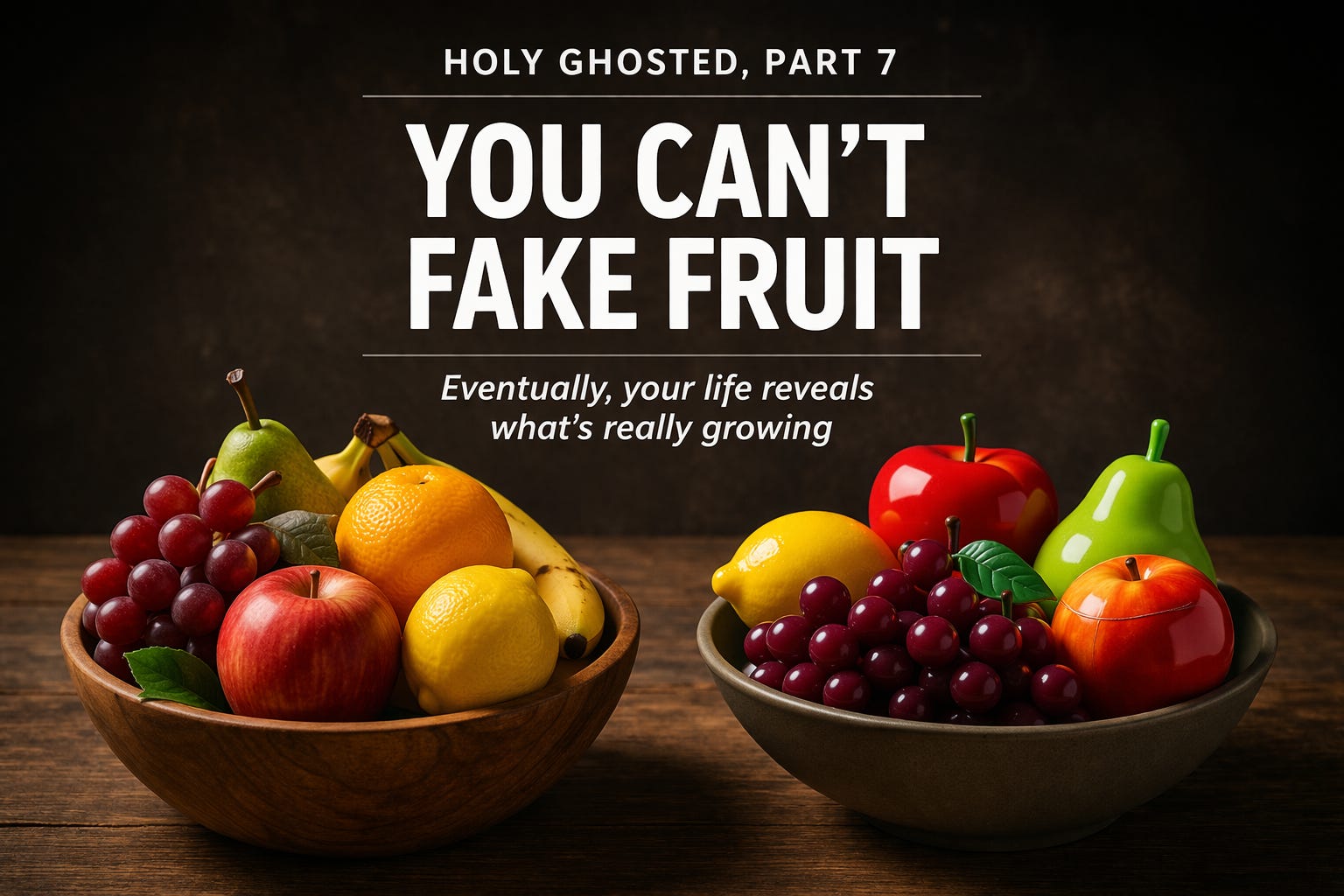
Jesus said something that should be foundational to the way we think about what it means to follow Him. And yet, I’m not sure it is.
“You will recognize them by their fruits… So, every healthy tree bears good fruit, but the diseased tree bears bad fruit… Thus you will recognize them by their fruits” (Matthew 7:16–20).
You’ll recognize them…not by their gifts.
Not by how intense they seem in a worship service. Not by how confident they sound when they talk about God. Not by how impressive they are in a room, how much they know, or how powerfully they speak.
Jesus says that if you really want to know what kind of tree you’re dealing with, you don’t look for leaves. You look for fruit.
And we get that wrong all the time, don’t we?
We see somebody who’s gifted, expressive, persuasive, maybe even powerful in the way they carry themselves, and we instinctively assume that must mean the Holy Spirit is deeply at work in them. But Jesus says slow down.
A tree can look healthy from a distance. It can have thick branches, full leaves, and plenty of shade. It can look alive. The question is not whether it looks impressive from across the field. The question is what happens when you get close enough to inspect the branches. Is there fruit there or not?
Because you can fake it from a distance, but you cannot fake fruit forever. Eventually, someone will see the tree for what it really is. The Apostle Paul says the same thing in Galatians 5, just from another angle:
“But I say, walk by the Spirit, and you will not gratify the desires of the flesh” (Galatians 5:16).
Then he shows the two directions a life can go. On one side are “the works of the flesh,” and he says they are “evident”:
“…sexual immorality, impurity, sensuality, idolatry, sorcery, enmity, strife, jealousy, fits of anger, rivalries, dissensions, divisions, envy, drunkenness, orgies, and things like these” (Galatians 5:19–21).
That’s one kind of life. It may have moments. It may have energy. It may even have a kind of intensity to it. But underneath it, there is a pattern—a direction—that is pulling away from God, not toward Him. Paul contrasts it with something completely different:
“But the fruit of the Spirit is love, joy, peace, patience, kindness, goodness, faithfulness, gentleness, self-control…” (Galatians 5:22–23).
That’s the evidence.
Not a moment. Not a spike of emotion. Not a powerful experience you can point back to. A pattern. A life. A steady, growing resemblance to Jesus over time.
The Holy Spirit doesn’t just show up in your life to give you moments. He takes up residence to change you into someone who bears much fruit.
Which is why you can have a lot of activity and still miss the point. You can have leaves without fruit. You can have the appearance of life without the substance of it. You can look like a healthy tree from a distance and still have nothing on the branches when someone gets close enough to see.
In Mark 11, Jesus sees a fig tree that’s “in leaf,” meaning it was presenting as if it had fruit. When He found that it had none, He cursed it, causing it to wither to its roots. And if we’re honest, that same dynamic shows up in our lives more than we’d like to admit.
It’s possible to have a life that looks “in leaf”—busy, active, even spiritual—and still have no real fruit. A lot of activity. A lot of appearance. But when you get past the surface…nothing that actually reflects Jesus.
Here’s the thing: we can fool other people with our leaves. And if we’re not careful, we can even fool ourselves. But we can’t fool Jesus.
Jesus is not impressed by activity without substance.
Because when we go that route, we usually end up drifting towards one of two extremes.
Dad’s fence
When you have kids, everything changes.
All of a sudden, you start seeing your house differently. That kid starts crawling, and you look around and realize you’ve been living in a horror house of dangers. Outlets everywhere. Cleaning chemicals under the sink conveniently stored to poison small versions of you. Stairs just waiting to launch someone headfirst. Furniture that could tip over. Knives sitting out. It’s chaos.
So what do you do?
You baby-proof everything. Gates. Outlet covers. Cabinet locks. You secure furniture. Not because you want to limit your kids, but because you want to protect them. You’re trying to keep them alive.
And when they start walking, running, playing outside, you’ve got a new problem. There’s a busy street nearby. Cars—the natural enemy of toddlers. So what do you do?
You build a fence.
And you tell them, “Enjoy the whole yard. Run, play, explore, climb, do whatever you want. Just don’t go over the fence. There’s freedom in here. There’s danger out there.”
That’s what God’s commands are like.
They’re not there to rob you of life—they’re there to preserve life. God is a good Father. He’s not trying to restrict your joy. He’s trying to protect it.
But here’s what happens.
Religious people come along and say, “Well, if the fence is good…we should build another fence inside that fence. Just to make sure no one even gets close to the first one.”
And then someone else says later, “That second fence is great, but it’s still pretty close to the fence God build, so let’s build another one. A little higher. A little further inside. Just to be safe.”
And then someone else builds another fence. Then another. And another.
Until eventually, there’s no yard left. Just fences. What started as protection turns into a prison. And now people aren’t running and playing—they’re trapped. And they’re told, “This is what God wants for you.”
So what do people do? They rebel. They break out. And when they do, they don’t just leave the extra fences. They tear them all down—including the one God actually did build for their protection.
“No fences!” “Freedom!” “I decide what’s right for me.”
But now they’re back in the street. Different error; same danger.
The answer for both sides
Paul addresses both sides. To the fence-building legalistic side, he says:
“For freedom Christ has set us free… do not submit again to a yoke of slavery” (Galatians 5:1).
In other words, stop turning God’s backyard into a cage. But to the no-fence, hyper-freedom side running into traffic, he says:
“Do not use your freedom as an opportunity for the flesh…” (Galatians 5:13).
Freedom doesn’t mean you get to redefine what’s good, right, and true. And then he gives the key:
“If you are led by the Spirit, you are not under the law” (Galatians 5:18).
That doesn’t mean the Spirit leads you away from God’s commands. It means the Spirit leads you into them—freely, willingly, from the inside out. The Spirit doesn’t remove the fence. He changes your heart so that you find the life God created you to enjoy—in the yard He’s given you.
That’s where life is. That’s where freedom is.
Moments or maturity?
So how do you know if the Spirit is actually at work in your life?
Not by the moments. Not by the intensity. Not by whether you’ve had powerful experiences or can point to something dramatic.
But by the fruit.
Are you becoming more loving? More patient? More self-controlled? More faithful? More like Jesus?
Because you can have moments without maturity. You can have experiences without transformation. You can look like a healthy tree from a distance. But when someone gets close—when life presses in—what shows up on the branches?
That’s the question.
In the end, this isn’t about what you can point to in a moment. It’s about what shows up over time. Not what you can perform—but what you’ve become.
And just to be clear: the answer isn’t to try harder to produce fruit. That just turns into another version of legalism. Paul already told us how it works:
“If we live by the Spirit, let us also keep in step with the Spirit” (Galatians 5:25).
Walk with Him. Stay in step with Him. Follow His lead. And over time, fruit grows. Not instantly. Not perfectly. But steadily.
Because the Holy Spirit doesn’t just make you powerful. He makes you like Jesus.
And in the end, that’s the only thing that proves He’s really at work.

PS — If this served you, consider becoming a paid subscriber to fund the book I’m working on and get extras (occasional printables, verse cards, discussion guides, journal prompts, and more). Thank you for fueling this work.
